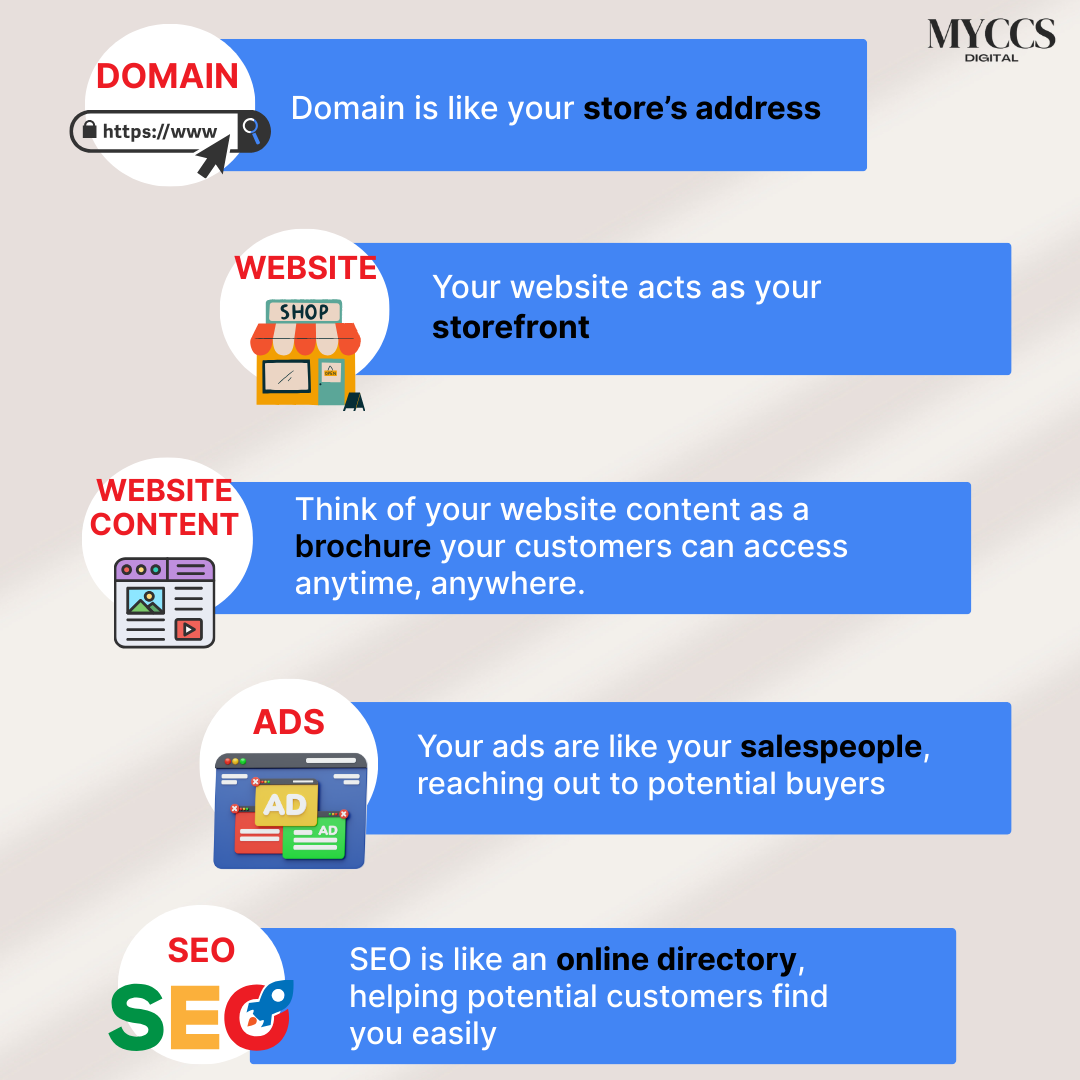
1. Domain: Your store’s address
What it is: A domain is the web address customers type or click to reach you.
Why it matters: A memorable, professional domain builds confidence before a visitor even clicks.
Best practices
-
Choose a short, brandable domain that matches your business.
-
Use HTTPS (secure certificate), it’s safe and builds trust.
-
Avoid long strings or strange characters that look spammy.
Quick checklist
✅ Domain is easy to pronounce and spell
✅ SSL certificate (HTTPS) active
2. Website: Your storefront
What it is: The website is where visitors browse your products, services, and story
Why it matters: A clear, helpful website reduces friction and turns curious visitors into leads or customers.
Practical copy & design tips
-
Above-the-fold headline: Communicate your main benefit in one sentence.
-
Visual hierarchy: Use clear CTAs (e.g., “Get a Quote”, “Book Now”)
-
Mobile-first: Most visitors will view on mobile, test for speed and usability.
Trust signals to include
-
Client testimonials, case summaries
-
Transparent pricing
-
Contact details and a visible phone/WhatsApp CTA
3. Website content: Your brochure
What it is: Pages, blog posts, product descriptions, FAQs, the content that educates and persuades.
Why it matters: Good content tells customers why you’re the right choice and helps search engines understand you.
How to write content that converts
-
Use benefit-led headlines and short paragraphs.
-
Lead with the customer problem and show how you solve it.
-
Include real-world examples or short case studies to show outcomes.
Content checklist
✅ Clear service/product pages with benefits and outcomes
✅ FAQ addressing common objections
✅ One-to-two clear and strong next step action per page (CTA, contact form, or chat)
4. Ads: Your salesperson
What it is: Paid campaigns (Facebook, Google, etc.) that bring targeted visitors to your storefront.
Why it matters: Ads scale visibility quickly when the landing pages are ready to convert.
Ads that perform
-
Align ad message with landing page headline and offer (message match).
-
Use value-based copy: highlight outcome, not just features.
-
Test small variations (headline, image, CTA) to learn what resonates.
KPIs to watch
-
Cost per click (CPC): How much it costs to attract traffic
-
Conversion rate (CVR): How many visitors take the desired action
-
Cost per acquisition (CPA): How much a lead or sale costs
5. SEO: Your online directory
What it is: Search Engine Optimization makes your site discoverable to people actively looking for what you offer.
Why it matters: SEO brings low-cost, high-intent traffic that compounds over time.
SEO quick wins
-
Optimize title tags and meta descriptions with your primary keyword
-
Use clear H1s and logical headings so both users and search engines understand the page.
-
Create helpful, original content that answers common customer questions.
Technical basics
-
Fast page load times, mobile responsiveness, and structured data where relevant.
-
A clear site map and robots.txt that don’t block important pages.
Common mistakes we see
-
Mismatch between ads and landing pages: Make sure ad promise = landing page delivery.
-
No visible contact method - Add a phone, WhatsApp, or any contact method
-
Too much jargon - Write like a helpful human: benefits first, then features.
-
Neglecting trust signals - Add reviews, guarantees, warranty, how your product/service benefits them and transparent policies.
- Visitors not sure what are you selling - Use layman term and be direct on website